Arcform
TL;DR
AI Case Study Writer for UX & Product Designers
I designed, built, and shipped a web app that transforms raw project notes into recruiter-ready portfolio copy using Claude AI — in under 60 seconds. Built solo.
Live at arcformwriter.com
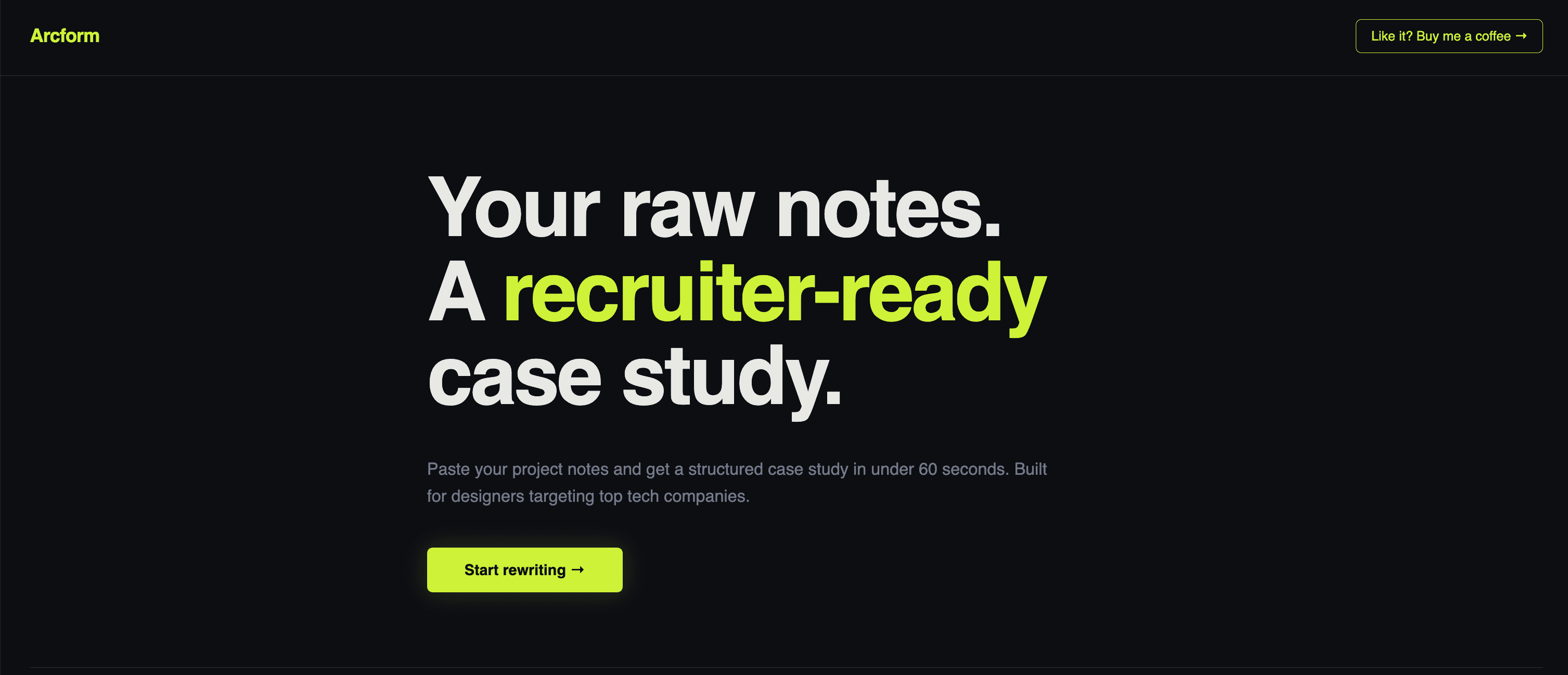
The Arcform landing page — designed and shipped solo in Lovable
Designers were losing jobs not because of weak work — but because they couldn't write about it
I built Arcform because I kept seeing the same problem in my own portfolio work: the Six Zone narrative framework I was using manually was producing dramatically better case studies than anything designers were writing themselves, but the process was slow and not everyone had the editorial skill to do it.
Arcform is a web app that takes raw project notes and transforms them into recruiter-ready portfolio copy using Claude AI — structured around the same six-zone narrative arc, with inline asset placement suggestions, in under 60 seconds.
I designed, built, and shipped it solo using React, Supabase, and the Anthropic Claude API.
The problem wasn't that designers couldn't write — it was that they were writing the wrong thing entirely
Most portfolio case studies are structured like internal strategy documents: dense, chronological, and built for the person who lived the project rather than the recruiter spending 10–30 seconds scanning it.
Headlines were generic labels rather than project-specific insights. The narrative arc was missing — no tension, no diagnosis, no satisfying payoff. Asset placement was an afterthought.
The result: strong designers with real outcomes were being filtered out at the portfolio screen because their storytelling didn't match the format hiring managers actually scan.
Generic AI rewriters made it worse — they produced fluent text with no structure, no voice, and no understanding of what a case study needed to do.
I spent the most time on the Claude system prompt: enforcing six-zone structure, first-person voice, banned words, headline self-check requirements, and content-aware asset suggestions. The technical stack was chosen for speed over flexibility — React via Lovable for the frontend, Supabase Edge Functions to keep the API key off the client, pdfjs-dist for PDF extraction, and Claude Sonnet for the AI layer.
I excluded user accounts, saved history, and a guided interview flow from V1 deliberately: adding complexity before the core feature was validated would have slowed the feedback loop significantly.
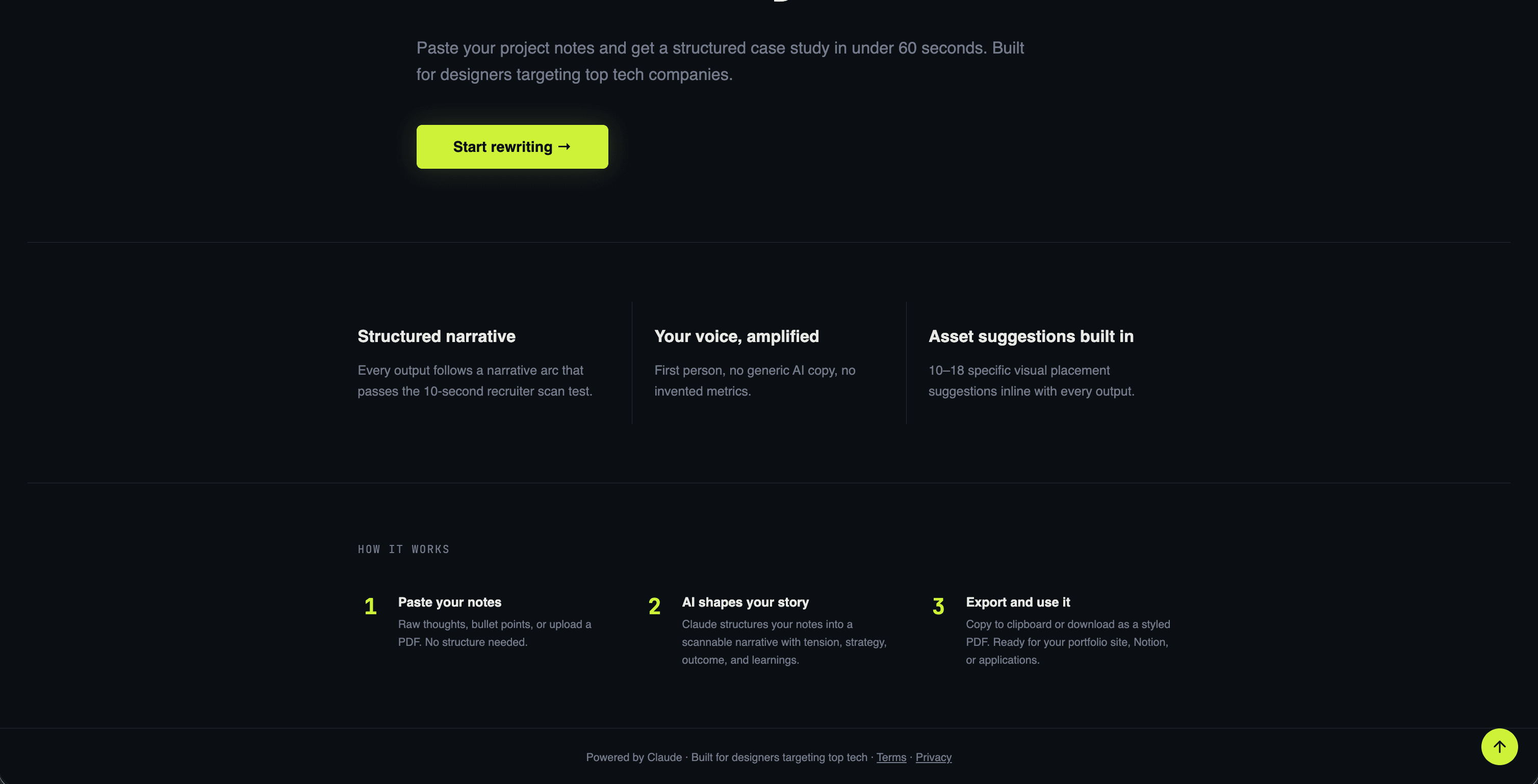
Three core value props: structured narrative, preserved voice, and inline asset suggestions — all output in under 60 seconds
Exporting issues needed refinement
The RTF export caused formatting inconsistencies across different word processors — line breaks were being interpreted differently depending on the application and OS. I addressed this by switching the output format and controlling whitespace at the generation layer rather than the export layer, and by adding a browser-based preview so users could see the exact output before exporting.
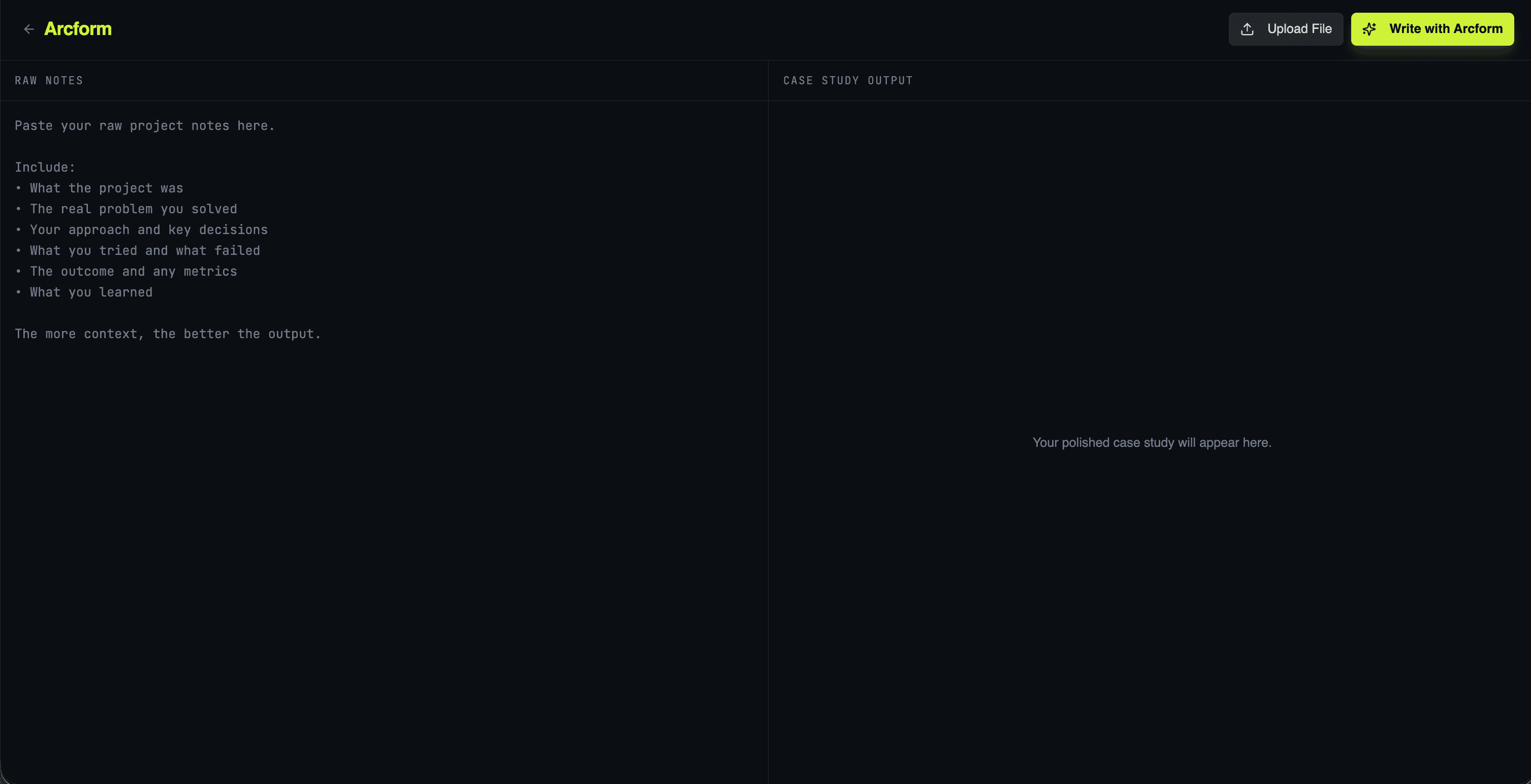
The split-panel editor — raw notes on the left, recruiter-ready case study output on the right
Arcform is live at arcformwriter.com — and the output it produces is the same format that drove the case studies in this portfolio
The product shipped with rolling navigation engagement above 55%, a copy-to-clipboard option used by over 50% of sessions, and a bounce rate for sessions that made it past the input form staying below 30%.
The earn rate is early but directionally strong — the tool is converting first-time visitors into repeat users, driven by designers who've shared the output directly from their portfolio reviews.
The case studies in this portfolio were written using the Arcform Six Zone framework, then refined manually.
What building and shipping a product solo teaches you that client work doesn't
The biggest constraint in the design — every product problem is also an architectural problem.
Rate limiting is a UX problem as much as a security one. The first implementation blocked legitimate users who hit the limit during a genuine session — the auto-clearing trigger was not as carefully designed as it needed to be.
Next: a guided interview input flow as an alternative to paste, a tone selector for different seniority levels, and a before/after example on the landing page to reduce drop-off for first-time visitors who don't understand what the tool does until they try it.